
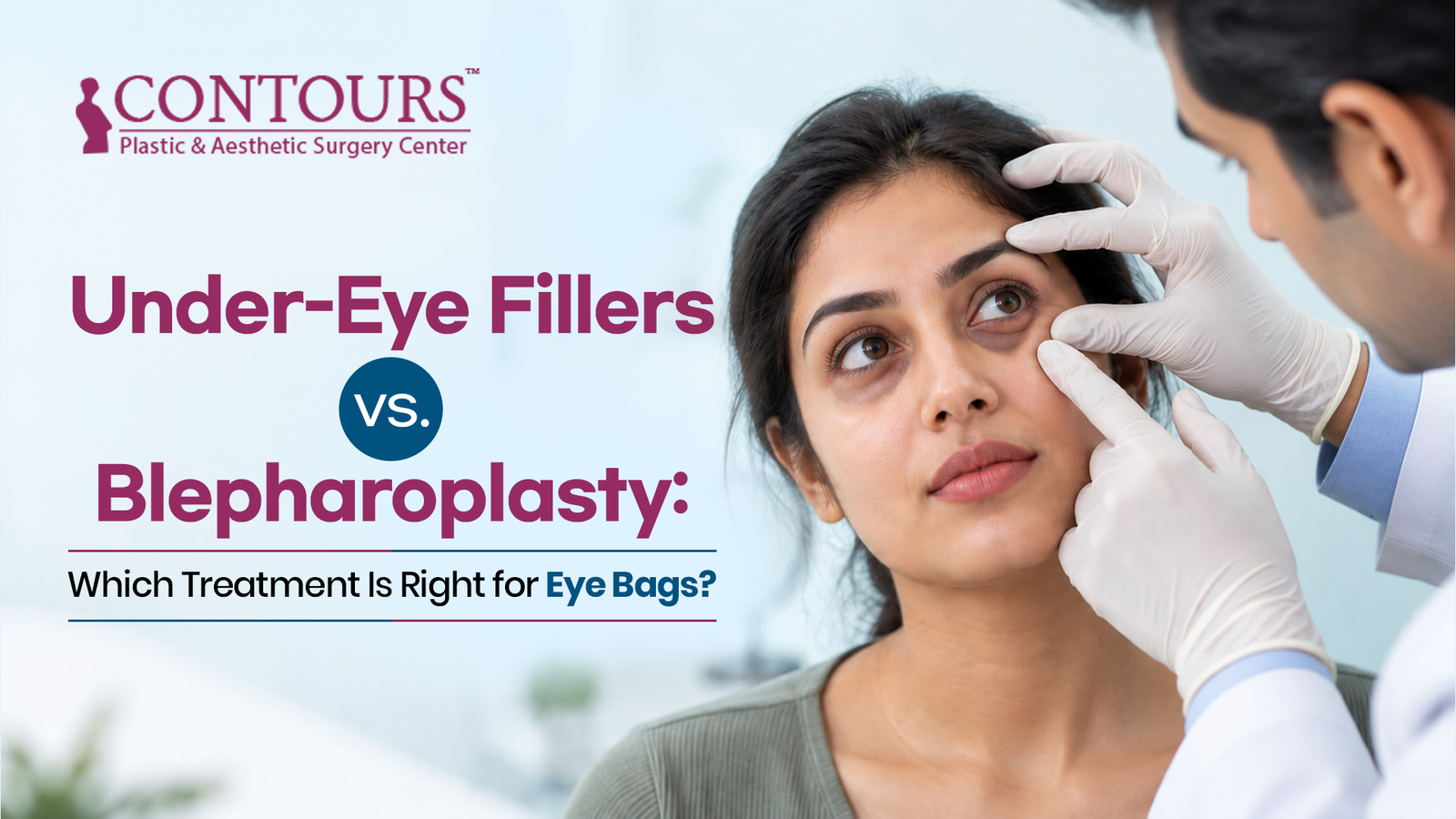
A regular at Contours, somewhere in her mid-thirties, once said something that stuck: she wasn’t tired, she just looked tired, all the time, no matter how much she slept. That gap between how someone actually feels and how their face reads to everyone else is usually what brings people into a consultation asking about under-eye fillers versus blepharoplasty in the first place.
Eye bags have a way of making a rested person look exhausted and a young face look older than it is, and once that starts showing up in every photo and every video call, most people start looking for an actual fix rather than another concealer.
The tricky part is that there are two genuinely different routes here, not one obvious answer. One involves a needle and takes about twenty minutes. The other is a surgical procedure with real downtime. Both work, just not for the same person or the same problem, and figuring out which one applies usually comes down to a proper assessment rather than guesswork.
This blog walks through both options plainly, using Contours Plastic & Cosmetic Surgery Center in Hyderabad as the reference point for how that decision typically gets made.
What’s Actually Causing Those Eye Bags in the First Place?
Before picking a treatment, it helps to know what’s actually going on under the skin, since fillers and surgery solve fairly different problems. The usual culprits include:
Sometimes it’s one of these on its own. More often, especially past the mid-thirties, it’s a mix of a couple of them at once – which is usually why one treatment alone doesn’t always solve everything on its own.
Under-Eye Fillers: The Non-Surgical Route
How Under-Eye Fillers Actually Work?
Under-eye fillers use a hyaluronic acid gel, injected carefully into the tear trough area, to fill in the hollow that sits between the lower lid and the cheek. It doesn’t remove anything, it just adds volume back to a spot that has lost it – which is why fillers work best when hollowing, not bulging fat, is the main issue.
Who Tends to Be a Good Candidate for Fillers?
It’s worth being honest about the limits here too. Fillers can soften hollows and shadows, but they generally can’t fix loose, sagging skin or a genuinely bulging fat pad – that’s really where surgery starts to make more sense.
Blepharoplasty: The Surgical Route
How the Procedure Works at Contours – Plastic & Cosmetic Surgery Center?
Blepharoplasty, or lower eyelid surgery, physically removes or repositions the fat and excess skin causing the bag. There are two common approaches, and the choice usually comes down to what exactly needs correcting:
Who Tends to Be an ideal Candidate for Surgery?
Under-Eye Fillers vs. Blepharoplasty
| Aspect | Under-Eye Fillers | Blepharoplasty |
| What it corrects | Hollowness and shadowing (tear trough volume loss) | Bulging fat pads and excess or sagging skin |
| Procedure time | 15 to 30 minutes, usually in-clinic | 45 minutes to just over an hour, depending on extent |
| Anaesthesia | Topical numbing cream only | Local or general anaesthesia, based on the case |
| Downtime | Minimal; mild swelling for a day or two | 1 to 2 weeks before returning to normal activity |
| How long results last | Roughly 9 to 15 months, depending on the product | Long-lasting, often considered a permanent correction |
| Reversibility | Can be dissolved if needed | Permanent, not reversible |
| Best suited for | Early volume loss, subtle correction | Visible fat bulges, loose skin, more defined ageing signs |
So, Which One Actually Fits – Fillers or Surgery?
There isn’t a universal right answer here, honestly, and anyone promising one probably hasn’t looked closely enough at the actual face in front of them. A rough way to think about it:
This is exactly the kind of call that benefits from an actual consultation rather than a quiz on the internet, since two people with similar-looking bags can have completely different underlying causes.
What the Process Looks Like at Contours – Plastic & Cosmetic Surgery Center?
The assessment usually starts with a close look at the skin, the underlying fat, and how the lower lid sits against the cheek – the kind of examination that draws on Dr. Y. Venkata Ramana’s background in both plastic surgery and ENT-adjacent facial anatomy. That combination tends to matter here too, since the periorbital area is dense with small structures, and planning around them carefully is part of what keeps results looking natural rather than overdone.
Patients usually leave that first meeting with a fairly clear idea of which route fits their case, along with realistic expectations about what change is actually achievable – which, more often than not, is the part people appreciate most about the whole process.
Risks and Realistic Expectations
Neither option is entirely risk-free, though complications tend to be uncommon with an experienced team and a properly assessed plan.
| Concern | Fillers | Blepharoplasty |
| Bruising or swelling | Common for a day or two, settles on its own | Expected for the first week, part of normal healing |
| Lumps or irregularity | Possible if placed too superficially; correctable | Rare, usually tied to technique or healing |
| Infection | Uncommon with sterile technique | Managed with standard surgical precautions |
| Under-correction or overfilling | Can be adjusted or dissolved | Requires a revision procedure if it occurs |
| Dry or irritated eyes | Not typically associated with filler | Temporary in some cases, usually resolves |
Why Contours – Plastic & Cosmetic Surgery Center Is a Trusted Choice for Eye Rejuvenation in Hyderabad?
Frequently Asked Questions (FAQS) About Under Eye Fillers Vs. Blepharoplasty
1. How long do under-eye fillers usually last?
Most patients see results holding for around nine to fifteen months, depending on the product used and how quickly the body metabolises it. Touch-ups are generally needed to maintain the look.
2. Is blepharoplasty a painful procedure?
Not during the surgery itself, since it’s done under local or general anaesthesia depending on the case. Afterward there’s usually some mild discomfort, bruising, and swelling that settles within one to two weeks.
3. Can under-eye fillers and blepharoplasty be combined?
Yes, in some cases. When both hollowing and fat bulging exist together, a combined approach – filler for volume, surgery for the fat pad – can give a more complete result than either treatment alone.
4. What’s the recovery time for lower eyelid surgery?
Most people take about one to two weeks off from work and social plans, though residual swelling can take a few more weeks to fully settle and reveal the final result.
5. Who should probably avoid under-eye fillers?
Those with significant loose skin, true fat bulging, or very thin under-eye skin prone to visible lumps are usually better candidates for surgery rather than filler, since injecting volume into an already stretched area can sometimes make the bag look more pronounced rather than less.
Filler or Blepharoplasty? Know What Your Eyes Really Need.
Eye bags rarely mean the same thing for any two people, so it makes sense that the fix isn’t one-size-fits-all either. Some cases call for a quiet, low-downtime filler appointment on a lunch break. Others genuinely need blepharoplasty to deal with skin and fat that filler was never going to fix.
Getting that distinction right the first time saves a fair amount of money, time, and disappointment later on. For anyone in the city weighing this decision, Contours Plastic & Cosmetic Surgery Center offers the kind of honest, assessment-first consultation that actually points toward the right answer instead of the easiest upsell.
Anyone tired of hearing “you look exhausted” on a good day probably just needs one proper consultation to find out which route actually fits their face.
Schedule your assessment today at Contours Plastic & Cosmetic Surgery Center, Hyderabad and find the right solution for your eyes.

We are open on

Contours CLINIC is the place where dedication meets profession. Our first motive is client satisfaction. With huge experience and advanced technologies, we are offering specific customized treatments for specific...
#8-2-120/112/P/5, 2nd Floor, Park View Estates, opp: KBR park, Road No. 2,Banjara Hills, Land Mark : Creame Stone, Hyderabad, Telangana State, India - 500034


